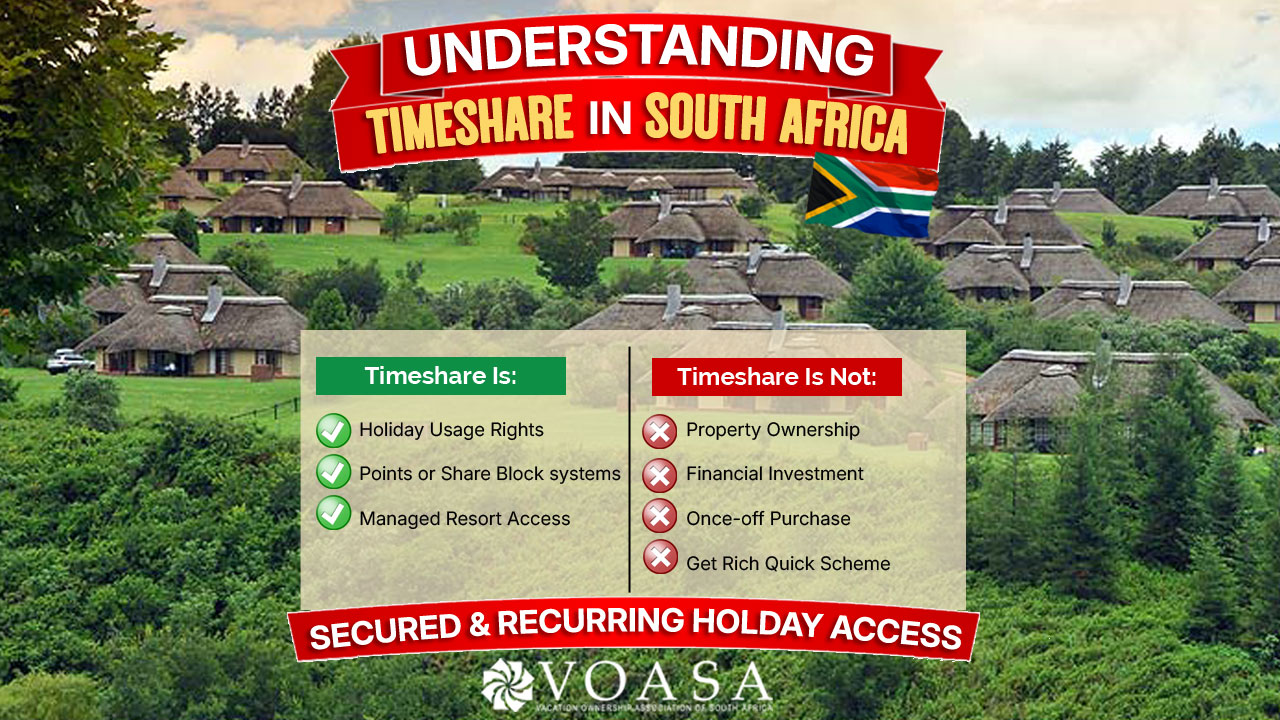
Timeshare remains one of the most widely used, yet frequently misunderstood, forms of holiday access in South Africa. Much of this misunderstanding arises from expectations that it functions as traditional property ownership or as an investment product, when it is neither. In South African law, timeshare is a right or interest in the exclusive use or occupation of accommodation for a determined or determinable period, sold or let for utilisation over a period of at least three years. In practical terms, this means that a consumer is not acquiring ownership of immovable property, but rather a structured right of use within a managed scheme. This right can take different forms within the South African market.
In a share block scheme, the consumer holds shares in a company, and those shares confer a right to or interest in the use of immovable property, typically linked to a specific unit and time period each year. In a points based system, the consumer receives points as a form of usage currency, which can be used to access accommodation across a portfolio of resorts, subject to availability and the rules of the system. Across both structures, the principle remains consistent. Timeshare provides secured, recurring holiday access within a professionally managed environment.
In many established systems, this access extends beyond a single resort. Through exchange partnerships and internal exchange initiatives, consumers can access a broader range of destinations, introduce variety into their holiday patterns, and in some instances extend the duration of their stay, depending on availability and usage parameters.
It is equally important to clarify what timeshare is NOT.
· Timeshare is not traditional property ownership.
· It is not a financial or speculative investment.
· It is not a once off purchase without ongoing financial responsibility.
· It is not an informal or unregulated arrangement.
Consumers contribute through levies, which fund the ongoing operation, maintenance and refurbishment of the resort. In return, they benefit from consistent accommodation standards and the ability to plan holidays with a level of certainty over the long term. The value lies in use and continuity, rather than resale expectations. Where transactions involve property practitioners or intermediaries, there are regulatory safeguards in place. These include compliance requirements under the Property Practitioners Act, including the proper handling of consumer funds through regulated trust accounts, which are subject to strict governance and oversight.
From a consumer perspective, many of the concerns that arise in the sector can be traced back to a mismatch between expectation and the actual nature of the product. Where timeshare is approached as an investment or as property ownership, it is often misunderstood. Where it is understood as a structured and shared approach to securing future holiday use, it will no doubt deliver its intended value! A clear understanding of what is being acquired remains central to consumer confidence, fair outcomes, and the long term sustainability of the vacation ownership
sector in South Africa.
Consumers are encouraged to seek clarity before entering into any agreement, and to ask questions where uncertainty exists. VOASA remains available to provide guidance, and you are welcome to contact us should you require further information or assistance.